Hi, I'm Brian Wu!
A curious and enthusiastic Mechanical Engineering undergrad interested in various fields, including aerospace, EVs, renewable energy, and robotics. My goal is to leverage my knowledge and experience to build solutions that benefit people at a broad scale. I see value in working with diverse minds and takes charge when projects need momentum. Welcome to my portfolio!
Experience
Mechanical Lead
- •Led weekly meetings to facilitate cross-functional communication between subteams on design architecture and team logistics
- •Established timelines for 80+ members, ensuring parallel progress on current vehicle overhauls and next generation vehicle design
Structures Co-Lead
- •Directed 13 projects to completion in 4 months by executing design reviews to validate designs for integration into the assembly
- •Mentored 20+ members in optimizing manufacturing and testing methods for structural projects
Composites Fabrication Lead
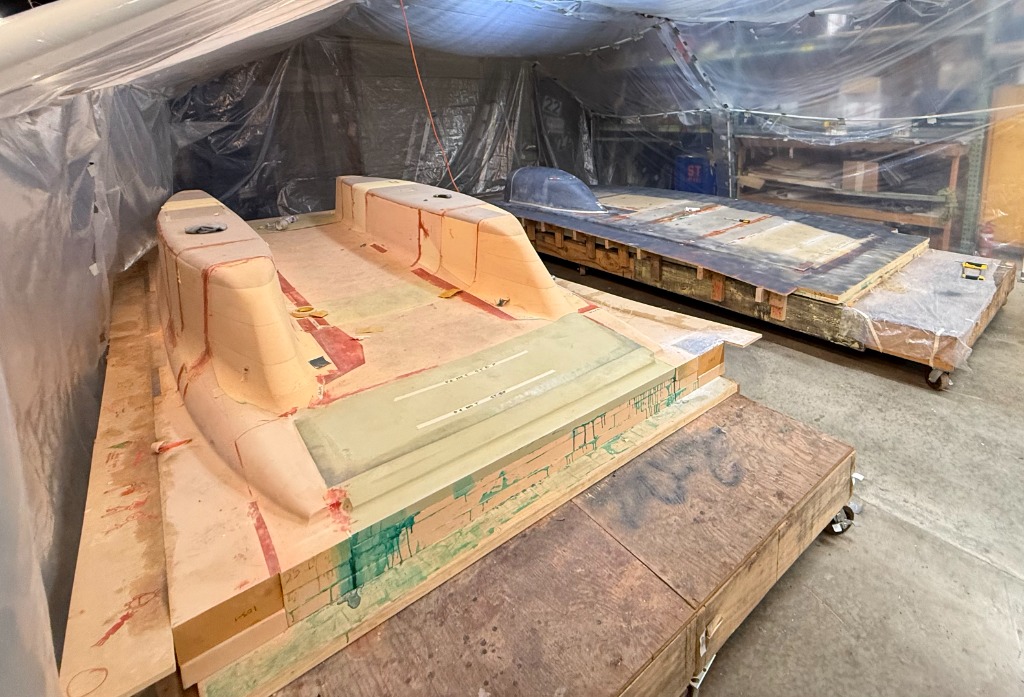
- •Directed 30+ members in the end-to-end fabrication of a carbon fiber chassis, from foam plug assembly and wet layup mold to final prepreg layup
- •Spearheaded the developement of a custom oven, expanding the team's in-house manufacturing capabilities and shortening fabrication time
- •Designed and constructed substructures to support carbon fiber mold to minimize warpage during curing
Facilities and Safety Director
- •Coordinated with multiple campus departments to manage the team’s workspace and equipment
- •Administered safety training, compliance, and logistics for 300+ members, maintaining a record of zero major incidents
President
- •Co-Founded and taught a robotics program for 50+ middle school students, partnering with the school to launch a STEM curriculum
- •Guided 20+ members in designing sensor-integrated robots to achieve two podium finishes at national competitions
Projects
Click on any card to expand project details, engineering specifications, and visual schematics.
Illini Solar Car
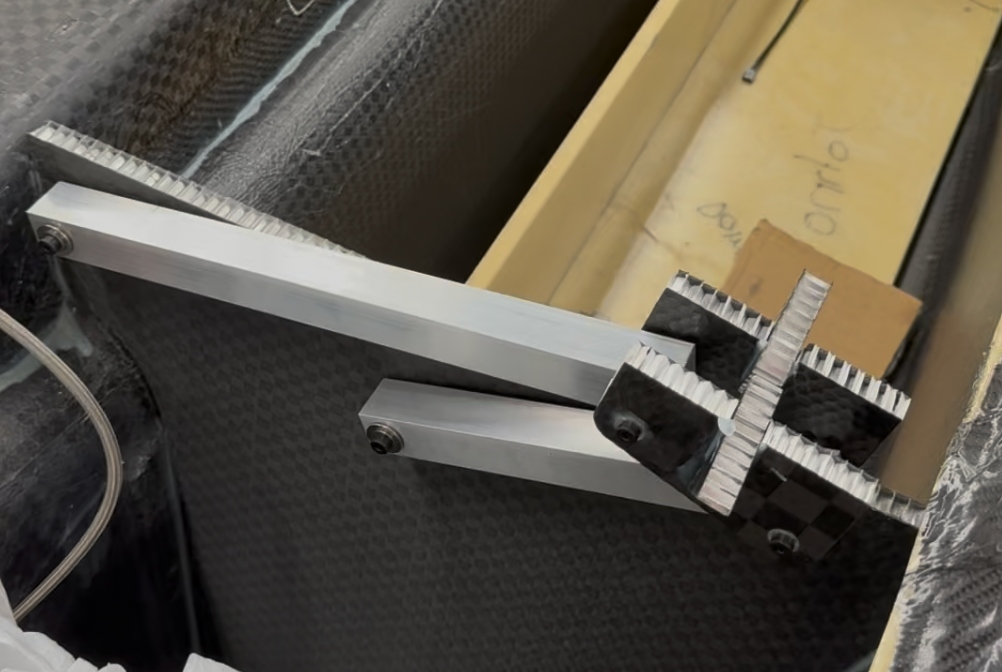
Top Shell Hinge
Overview:
Engineered the multi-link canopy actuation mechanism enabling smooth single-operator opening and rapid driver egress under Formula Sun Grand Prix safety regulations.
Key Contributions:
- ›Utilized two position linkage synthesis with coupler output to determine desired motion and position.
- ›Designed for assembly (DFA) with custom and standard components to deliver the project in a short timeframe.
- ›Validated kinematic clearance throughout canopy travel path to eliminate interference with aerodynamic fairings.
Impact:
Delivered the complete linkage assembly within a tight timeframe while ensuring precise canopy motion and locking alignment.
Rear Suspension Trailing Arm
Objective:
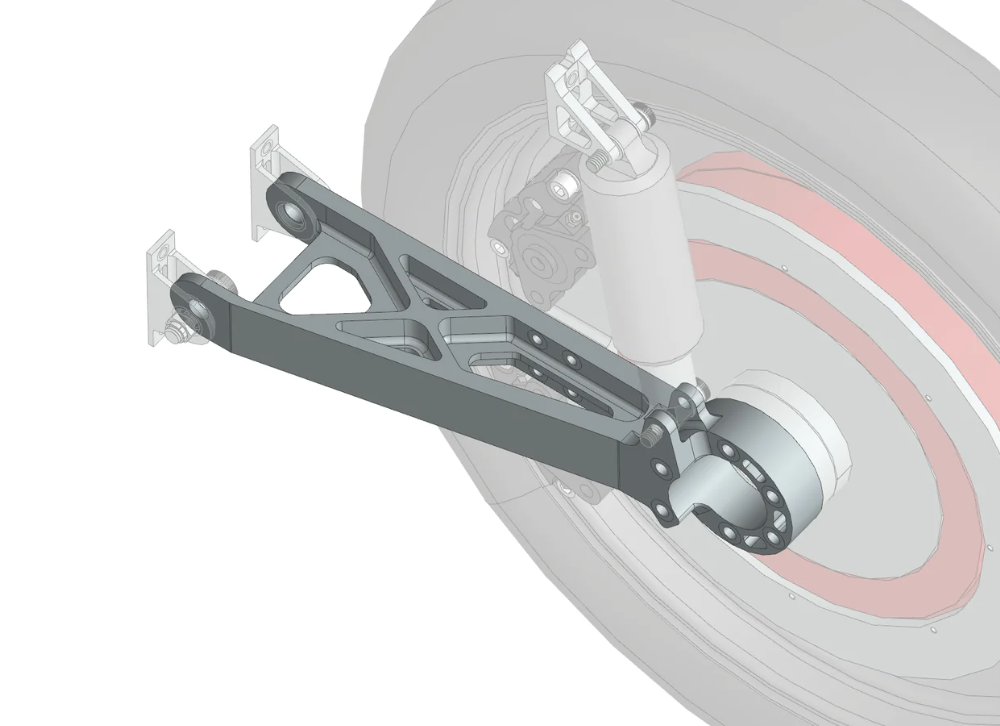
Design a trailing arm capable of withstanding 1G turn, 2G bump, and 1G brake loads for a rear suspension system
Method:
- ›Designed in Siemens NX
- ›Optimized based on stress/strain and safety factor analysis in ANSYS Static Structural FEA
- ›Load conditions were provided through a remote force at the wheel base
- ›Performed hand calculations to cross-check mount forces and validate simulation outputs
- ›Implemented cross-bracing to minimize torsion
Result:
- ›Achieved minimum safety factor > 1.5 under all load cases
- ›Reduced weight to 903g — a 56% decrease from prior design
- ›Decreased torsional deformation by 40%
- ›Designed for Manufacturability; component can be produced on a 3-axis mill
High-Voltage Battery Enclosure
Objective:
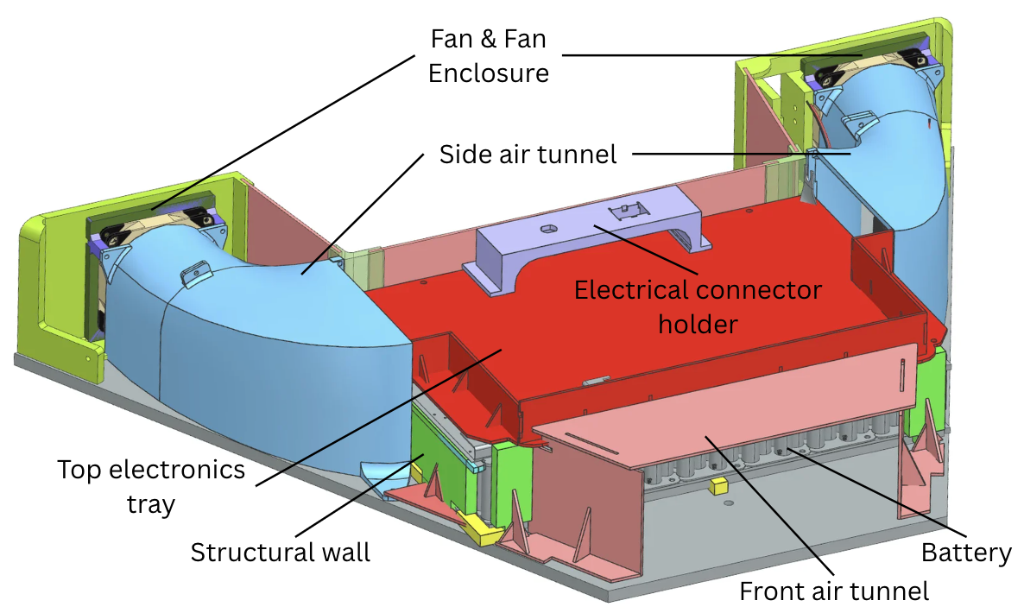
Design and fabricate a structural battery enclosure that maximizes airflow to keep battery temperatures within safe limits during racing
Method:
- ›Designed in Siemens NX
- ›Elevated battery to maximize airflow throughout the enclosure
- ›Top access to all electronic boards for quick troubleshooting
- ›Utilized different materials;
- •Fiberglass sandwich panel: Main structural walls (green) to hold the battery modules
- •Polycarbonate sheets: Top electronics tray (red) and front air tunnel (pink)
- •3D-printed PLA: Side air tunnel (blue) and connector holder (purple)
- •Aluminum: Bottom air guide/heat-sink (yellow)
Result:
- ›Maintained battery temperature below 35°C under race conditions
- ›Successfully implemented in the team’s 3rd-gen solar car, which won the Formula Sun Grand Prix 2025
Carbon Fiber Composites Layup
Research
Vision-Based Tactile Sensor
Objective:
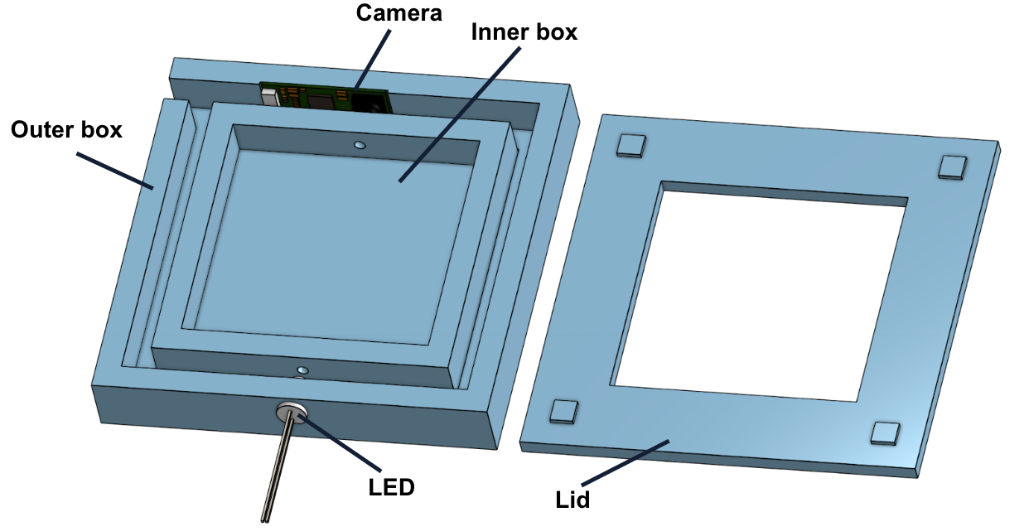
Design, prototype, and validate a Vision-Based Tactile Sensor using waveguides that can be easily scaled up without being limited by the camera’s POV
Method:
- ›Designed in Onshape
- ›Casted silicone with a shore hardness of 16 as the sensing surface
- ›Embedded a waveguide in the silicone made from a hollow core with slightly light-absorbing cladding
- ›An LED shines light from one end, and a camera captures intensity at the other
- ›When compressed, the waveguide bends and flattens, causing light to scatter and be partially absorbed by the cladding
Result:
- ›Clear correlation between applied force and pixel intensity
- ›Simple design and fabrication process enables scalable multi-waveguide arrays
- ›The sensor is only 15 mm thick (46% thinner than Gelsight Mini) with potential for further miniaturization
Capstone
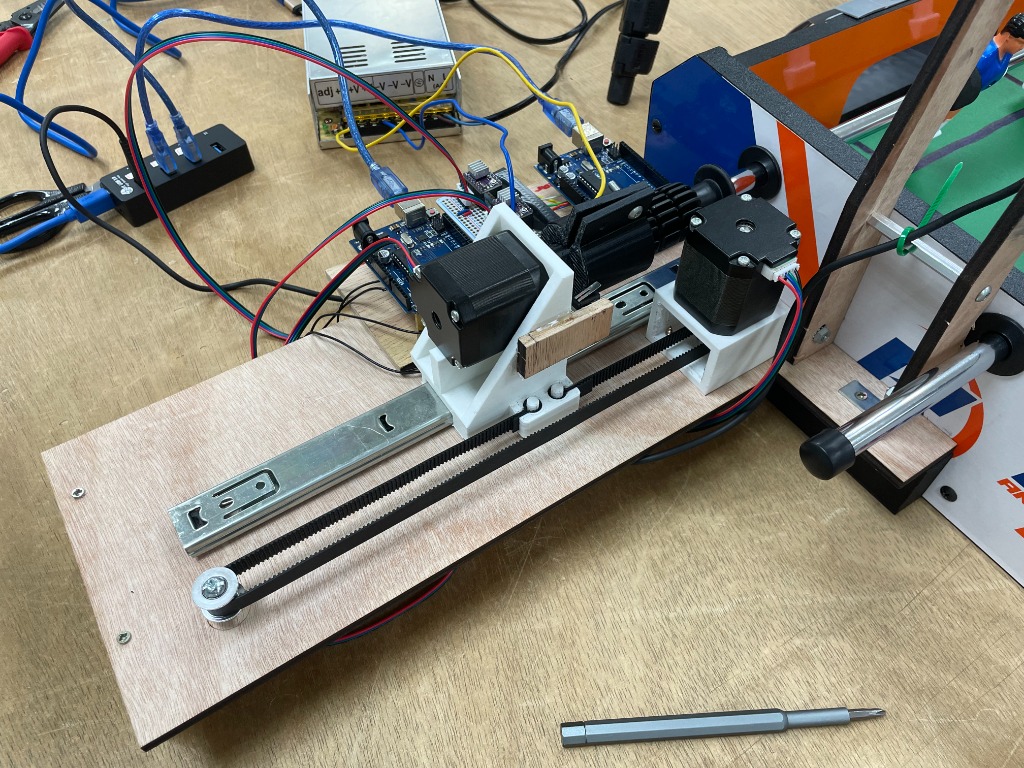
Automated Foosball table
Objective:
Design and build an autonomous robot attachment that plays foosball against live opponents using custom actuation, perception, and control systems
Method:
- ›Mechanical:
- •Designed in Fusion 360
- •Utilized 3D printed, laser-cut, and store-bought components
- ›Electronics:
- •Controlled stepper motors with Arduino and motor drivers
- •Designed and soldered circuits to connect all electronics
- ›Programming:
- •Used image contouring to detect the ball’s position
- •Applied kinematics to predict the ball's future position
- •Python algorithm calculates the player's target position
- •Arduino controls the motor to position the player and kick the ball
- •Synchronized subsystems with serial communication
Result:
- ›Tracks and responds to the ball in real time without noticeable delay
- ›Successfully plays against beginner-level human opponents